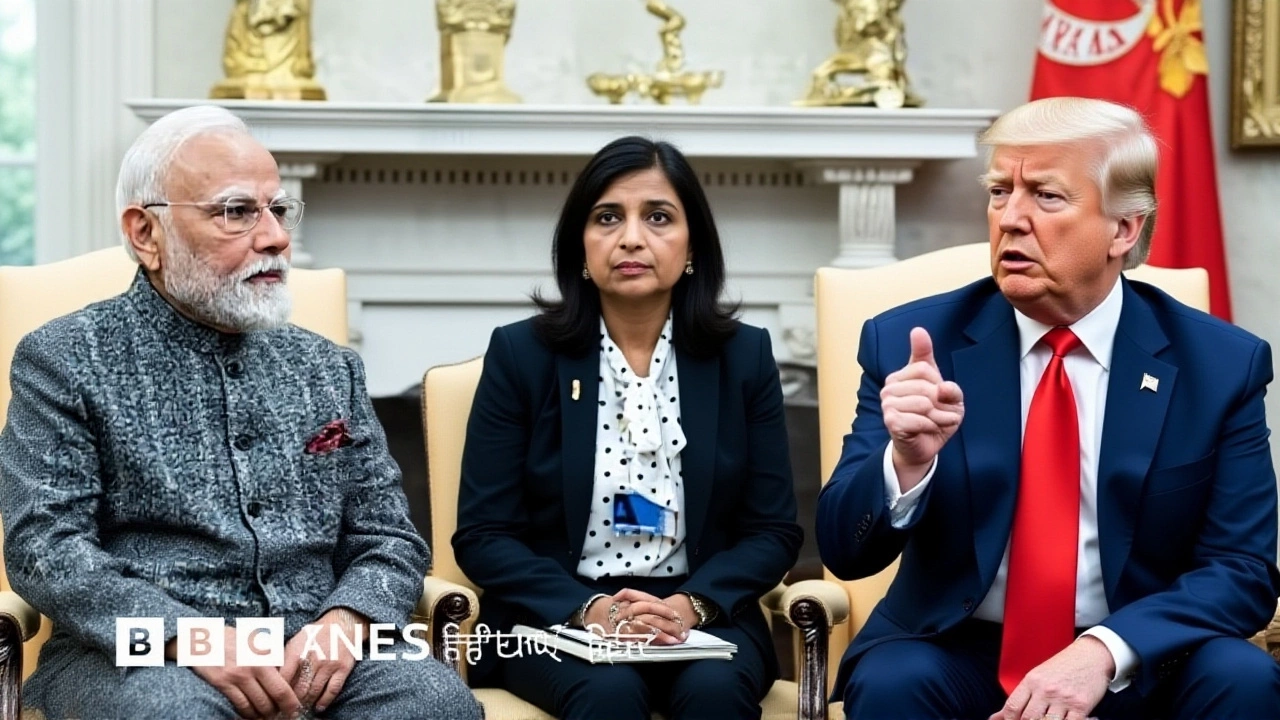
When Donald Trump, President of the United States, announced a temporary reprieve for Indian refiners last week, the message was clear: buy the oil already floating in the sea, but don't expect this to become permanent. The waiver, effective from March 5, 2026, through April 4, 2026, allows India to import Russian crude loaded before the deadline without facing immediate secondary sanctions.
New Delhi’s reaction? A firm reminder that it doesn’t need anyone’s permission to manage its energy security. While Washington calls India a "good actor" for complying with past restrictions, Indian officials are drawing a hard line on sovereignty. Here’s the thing—this isn’t just about oil prices. It’s a high-stakes diplomatic dance where energy needs clash with geopolitical pressure.
The Mechanics of the Temporary Waiver
The details matter here. This isn’t a blanket approval for all future shipments. The U.S. Department of the Treasury issued a specific license targeting only vessels that were already at sea or loaded prior to March 5, 2026. The goal? To prevent market disruption by allowing existing contracts to conclude without penalizing Indian buyers who acted in good faith under previous rules.
But wait—the restrictions are tight. The waiver applies solely to cargo destined for Indian ports. No transshipment to third countries. No re-exporting. And crucially, it does not alter the broader sanctions regime against Russia, Iran, or other sanctioned entities. U.S. officials argue this prevents Russia from gaining extra revenue while easing short-term global supply pressures. It’s a precision strike in policy terms, designed to keep markets stable without undermining long-term strategic goals.
New Delhi’s Firm Stance on Energy Sovereignty
While Washington frames this as a courtesy, Government of India is framing it as a non-issue. Officials have publicly stated that India requires no external authorization to purchase Russian crude. Decisions on oil imports, they insist, are driven by national interest and global market conditions—not foreign approval.
This stance has sparked debate. Is the 30-day waiver a concession or merely a technical adjustment within the U.S. sanctions framework? For New Delhi, it’s irrelevant. The narrative being pushed is one of sovereign independence. As one senior diplomat put it privately, "We buy what we need, when we need it." The subtext is loud: India will not be bullied into altering its energy strategy.

The Numbers Behind the Trade
To understand why this matters, look at the data. Since the Russia-Ukraine war intensified in 2022, India has dramatically increased its purchases of discounted Russian crude. In 2024 alone, India imported approximately 88 million tons of Russian oil. By September 2025, Russian crude accounted for roughly 34% of India’s total oil imports—a massive shift from negligible levels just a few years prior.
However, the winds may be changing. An anonymous White House official told Reuters that India has begun cutting Russian oil imports by 50%. Whether this is accurate remains unclear, as official Indian import data hasn’t yet reflected such a sharp decline. Refineries had already placed orders for November and December deliveries, so any reduction would likely appear in later quarters. Still, if true, this signals a significant pivot in India’s sourcing strategy.
Diplomatic Reactions and Future Implications
The reactions across capitals tell a story of diverging priorities. In Moscow, the Ministry of Foreign Affairs of the Russian Federation welcomed India’s continued purchases, calling them mutually beneficial and stabilizing for global energy markets. Kremlin spokesperson Dmitry Peskov noted that Russia has never been India’s sole supplier, emphasizing the natural diversification of India’s energy portfolio.
In Washington, the tone is more cautious. President Trump previously criticized India’s heavy reliance on Russian energy via his social media platform Truth Social, warning of potential tariffs and penalties. Recently, however, he acknowledged reports of reduced imports as a "good step," though he admitted uncertainty about their accuracy. Meanwhile, the U.S. has threatened a 25% tariff on all Indian exports unless trade imbalances are addressed.
Back in New Delhi, Randeep Surjewala, Spokesperson for the Ministry of External Affairs, reiterated the strength of India-Russia ties, describing them as "stable" and "time-tested." He highlighted cooperation beyond energy, including defense and technology, underscoring that these relationships predate current geopolitical tensions.
What Comes Next?
The clock is ticking. The current waiver expires on April 4, 2026. What happens then? Will the U.S. extend it? Tighten it? Or let it lapse entirely? Industry watchers suggest that prolonged uncertainty could force Indian refiners to seek alternative sources, potentially raising domestic fuel costs. Current petrol prices in New Delhi stand at ₹94.77 per liter, while diesel is at ₹87.67—figures sensitive to crude input costs.
Experts predict that India will continue to balance act. On one hand, maintaining strong relations with both the U.S. and Russia is vital for economic and strategic reasons. On the other, energy security cannot be compromised. Expect more nuanced negotiations, possible phased reductions in Russian imports, and perhaps new bilateral agreements aimed at mitigating sanction risks.
Frequently Asked Questions
Who is affected by the 30-day Russian oil waiver?
The waiver primarily affects Indian oil refineries and importers who have pending contracts for Russian crude that was loaded onto ships before March 5, 2026. It allows them to unload and process this oil in India without facing U.S. secondary sanctions during the 30-day window ending April 4, 2026. Consumers indirectly benefit if supply stability helps keep fuel prices lower.
Why did the U.S. grant this temporary exception?
The U.S. Department of the Treasury issued the waiver to prevent immediate market disruption and avoid penalizing Indian buyers who entered into contracts in good faith before the new enforcement date. It aims to stabilize global oil supplies temporarily without compromising long-term sanctions against Russia. Officials view India as a responsible partner that has largely adhered to international norms.
Is India reducing its Russian oil imports?
Reports from an anonymous White House official claim India has cut Russian oil imports by 50%, but official Indian data has not yet confirmed this drop. Refineries had pre-booked shipments for late 2025, so any reduction may take time to reflect in statistics. If sustained, this would mark a major shift in India’s energy sourcing strategy amid U.S. pressure.
How does this impact India-U.S.-Russia relations?
This situation highlights the delicate balancing act India performs between its strategic partnership with Russia and its growing economic ties with the U.S. While Washington pressures New Delhi to reduce Russian dependence, Moscow supports India’s sovereign right to choose suppliers. The waiver offers a short-term compromise, but long-term alignment depends on ongoing diplomatic and trade negotiations.

Write a comment